Short answer
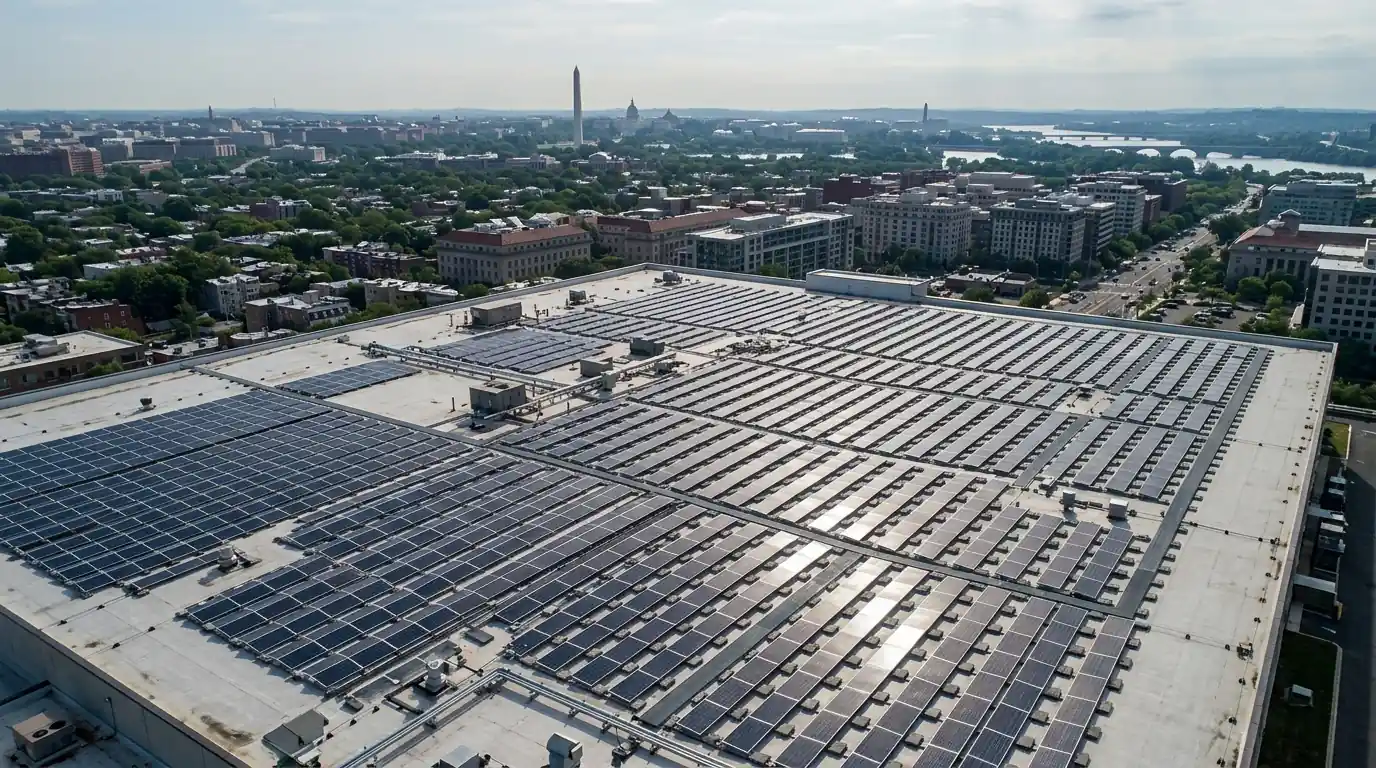
Commercial solar installation in Washington, DC usually means a ballasted or attached array on a flat roof, sized to the building's usage and roof area, at about $1.80 to $2.55 per watt for small business systems of 25 to 100 kW. DC SRECs add income on top of the bill savings, and the federal commercial credit has its own deadlines to check.
What the job is
What a commercial solar project involves
A commercial project starts with three questions: how much roof is usable, what the building's electrical service can accept, and who owns the building and the electric bill. The answers decide the system size, the interconnection path and whether the array should be owned outright, financed or built under a power purchase agreement with a third party.
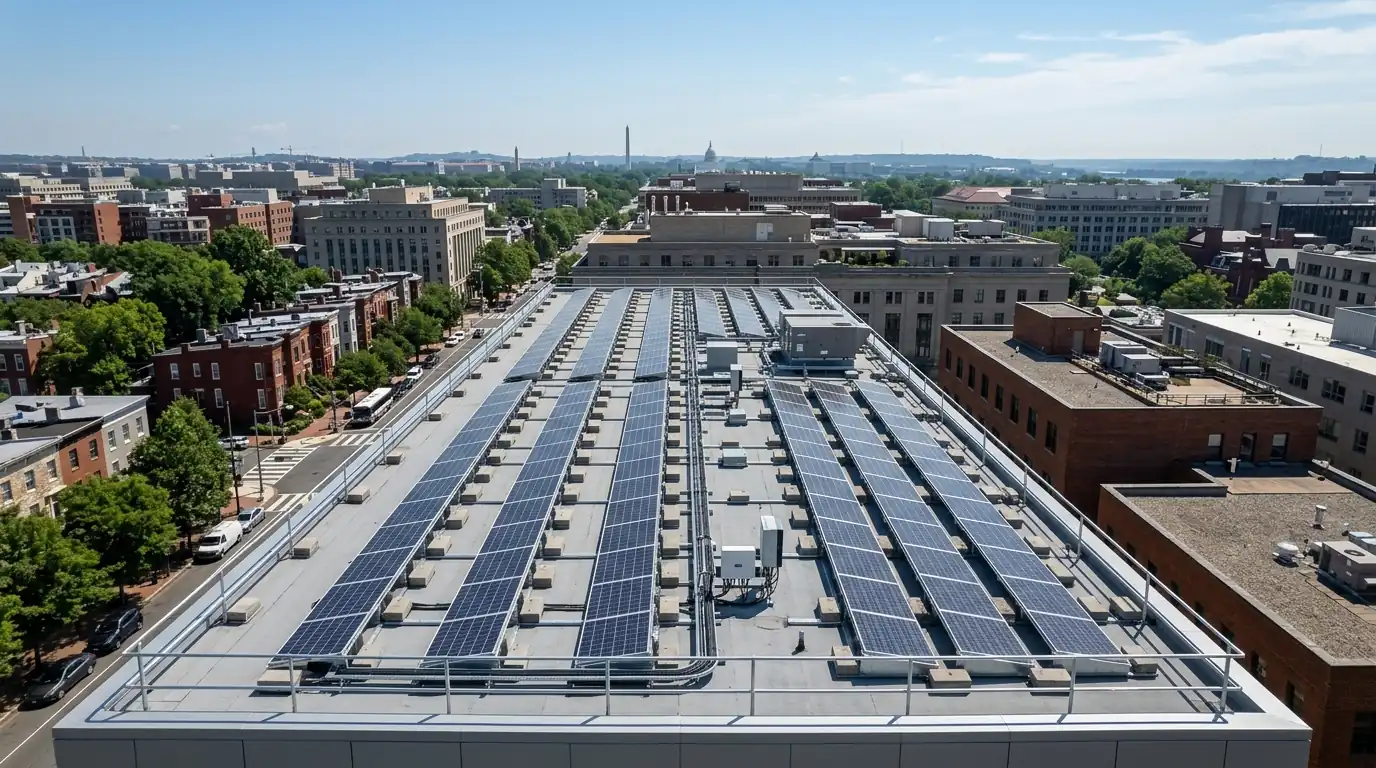
Commercial roofs bring their own constraints: rooftop mechanical units, setbacks the fire code requires around the edges, roof warranties that limit who can penetrate the membrane, and structural limits on ballast weight. We design within all of them and coordinate with the building's roofer where the warranty requires it.
What moves the price
What moves the price of a commercial system
- System sizeLarger systems cost less per watt.
- Roof structureWeight limits can force attachments instead of ballast.
- Electrical serviceService upgrades or new switchgear add significant cost.
- InterconnectionLarger systems can trigger utility studies and upgrades.
2026 planning ranges
- Small commercial solar, 25 to 100 kW$1.80 to $2.55 per wattSource: nuwattenergy.com
Published market ranges, not our quote. Your price depends on the roof, the equipment and the permit path.
Inside this job
Office and retail rooftops
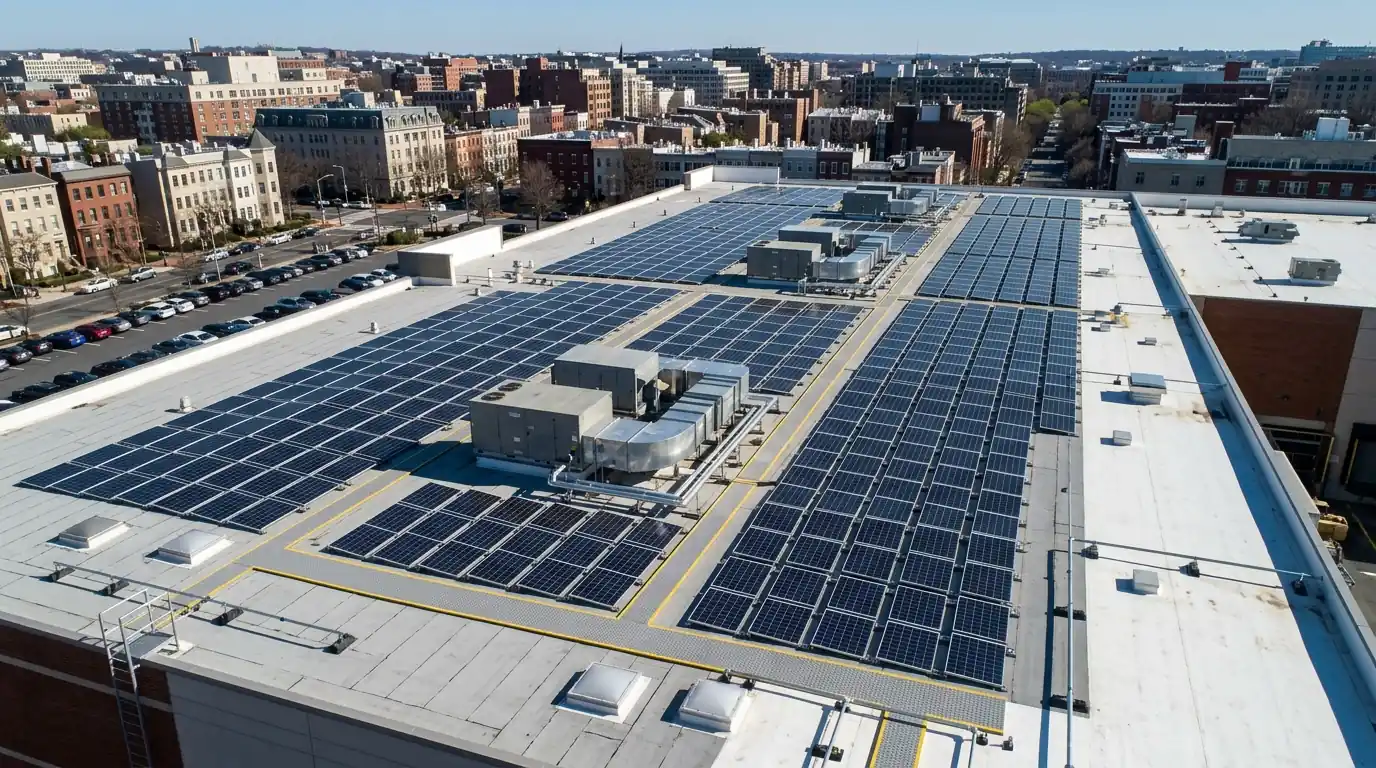
Office and retail buildings usually have flat roofs crowded with HVAC units, vents and hatches. The array fits around them with fire-code walkways and setbacks, often on ballasted racks so the roof warranty stays intact. Daytime business hours line up well with solar production, so more of the output is used on site rather than exported.
Nonprofits and houses of worship
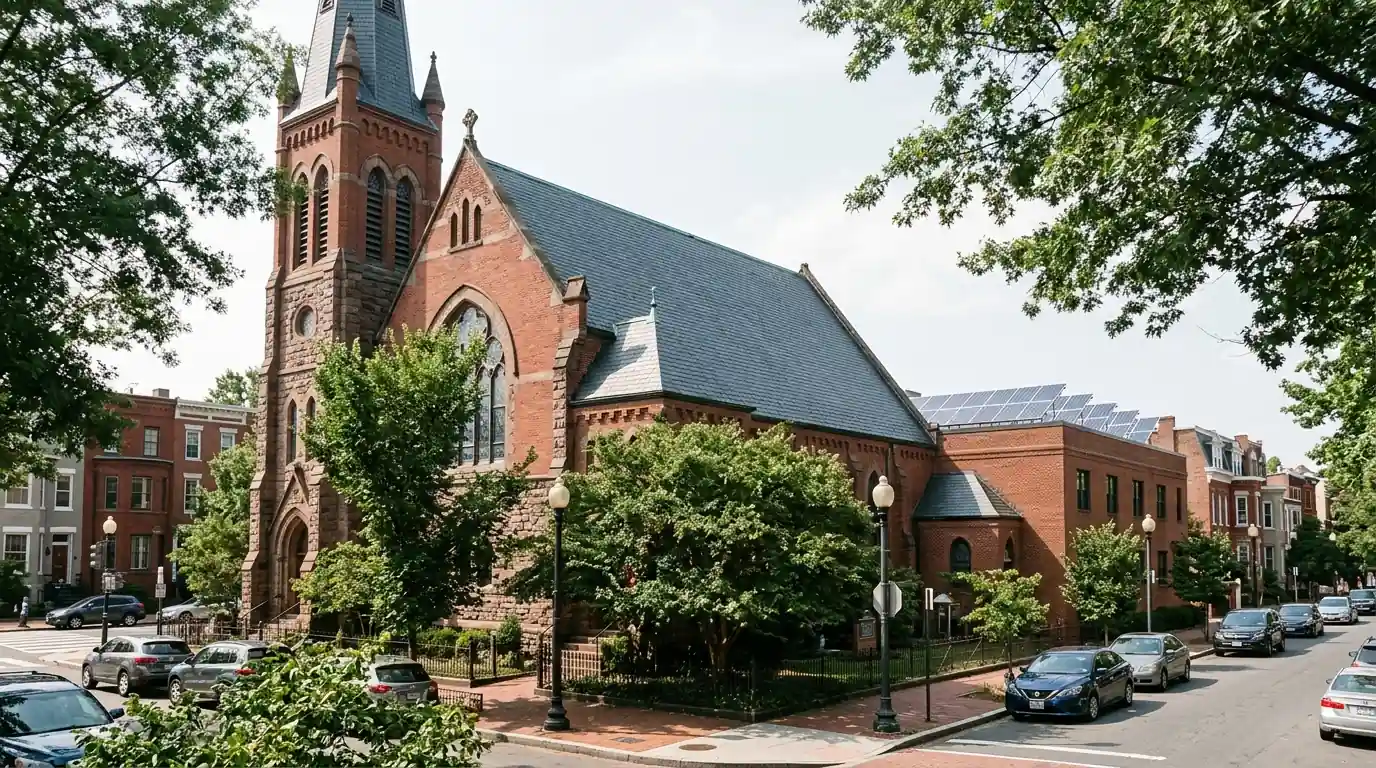
Nonprofits and congregations often cannot use tax credits directly, so the ownership structure matters as much as the design. Options include buying the system, financing it, or hosting it under a power purchase agreement where an investor owns the equipment and sells the power at a set rate. We explain how each affects the credits and the bills, and design the array to suit whichever path the board chooses.
Warehouse and flat commercial roofs
Large low roofs over warehouses and garages can carry bigger arrays, but the structure has to take the weight of panels and ballast. We review the roof structure and drawings, choose between ballast and attachments based on capacity, and lay out rows for maintenance access. Larger systems also mean larger interconnection studies with the utility.
Choosing between options
Own it, finance it, or host it?
| Buy outright | Finance | Power purchase agreement | |
|---|---|---|---|
| Who owns the system | The building owner | The building owner | A third-party investor |
| Upfront cost | Full | Low or none | None |
| Who earns the SRECs | The owner | The owner | Usually the investor |
| Best for | Owners with capital and tax appetite | Owners who want ownership without cash up front | Nonprofits and owners who want savings without ownership |
Washington conditions
DC's targets and commercial roofs
The District's renewable portfolio standard calls for 100 percent renewable electricity by 2032, with a local solar carve-out that rises from 5 percent in 2026 to 9 percent by 2032 and reaches 10 percent by 2041. Those requirements are why DC SRECs stay valuable, and why a flat commercial roof in Washington is worth more as a solar site than the same roof across the Maryland or Virginia line.
Step by step
How a commercial install runs
Discovery call
Building, roof, bills and how the property is owned.
Site and data review
Roof survey, structural drawings and a year of bills.
Proposal
System size, production estimate, structure options and price.
Permits and interconnection
Building permit and utility applications filed.
Installation
Scheduled around tenants and building operations.
Commissioning
Testing, utility approval, SREC certification and monitoring.
What is included
What a commercial project includes
- Roof, structure and electrical service review
- Usage analysis and system sizing
- Design with fire-code setbacks and walkways
- Permits, utility interconnection and any reviews
- Installation coordinated with building operations
- Commissioning and monitoring setup
- SREC certification and O&M options
Commercial systems we build typically pair Qcells, Canadian Solar or REC panels with SMA, SolarEdge or Fronius inverters on Unirac or IronRidge ballasted racking.
Straight answers
Commercial Solar Installation questions we hear in DC
Small business systems of 25 to 100 kW run about $1.80 to $2.55 per watt in 2026, with larger systems costing less per watt. Structure and electrical upgrades can move the number.
Yes. A power purchase agreement or a financed purchase can lower bills even when the organization cannot use tax credits directly.
Not if the installation follows the roof maker's requirements. We coordinate with the roofer where the warranty calls for it.
Yes. A certified system inside the District earns credits for every megawatt-hour it produces.
Yes. We schedule noisy or disruptive work around tenants and operations.
The commercial credit has continued past the residential credit's end, but its deadlines and requirements have tightened. Your tax advisor should confirm eligibility for your project.
Related work
Jobs that often come up alongside this one
Multifamily & Condo Solar
Solar for condo buildings and converted rowhouses.
See this job about Multifamily & Condo SolarCommercial Solar Maintenance
Scheduled upkeep and monitoring for business systems.
See this job about Commercial Solar MaintenanceResidential Solar Panel Installation
Pitched roof systems, from layout and permits to Pepco sign off.
See this job about Residential Solar Panel Installation