Short answer
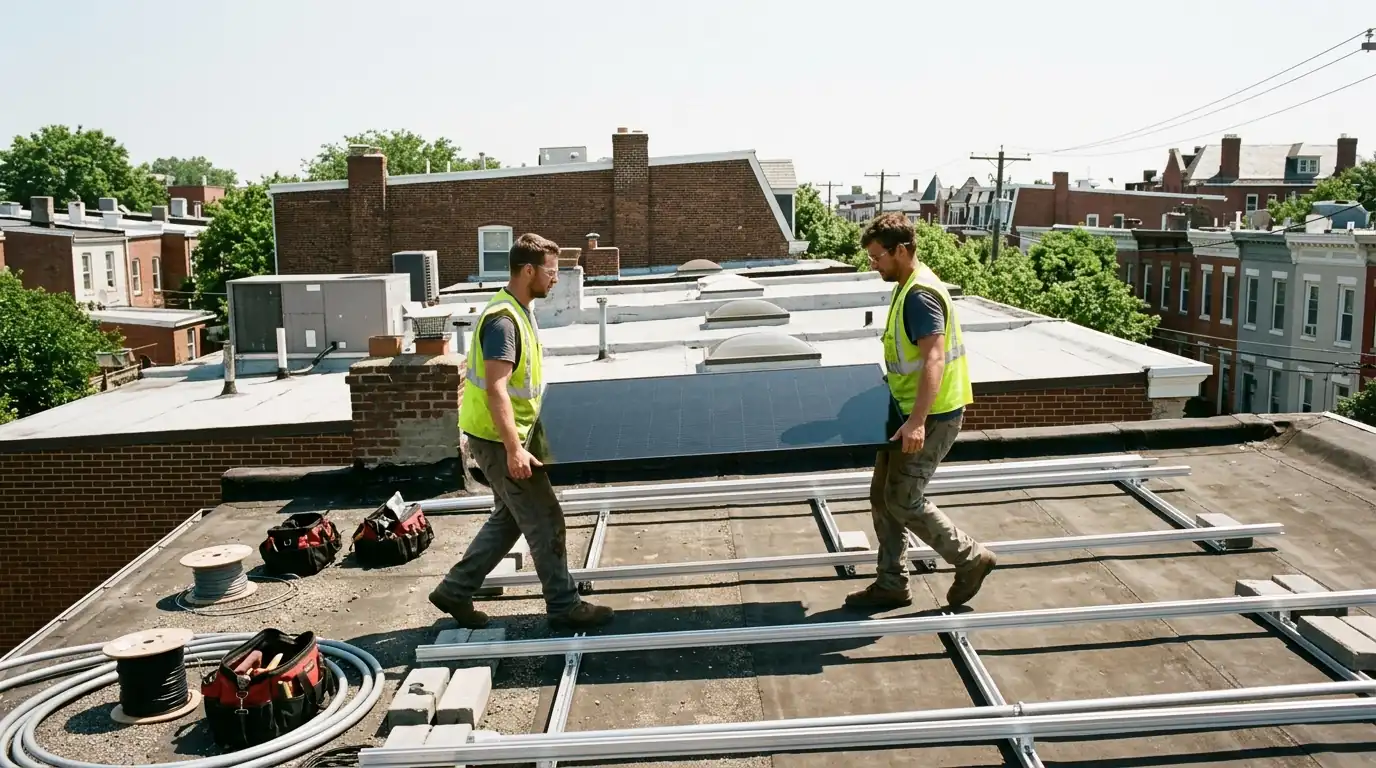
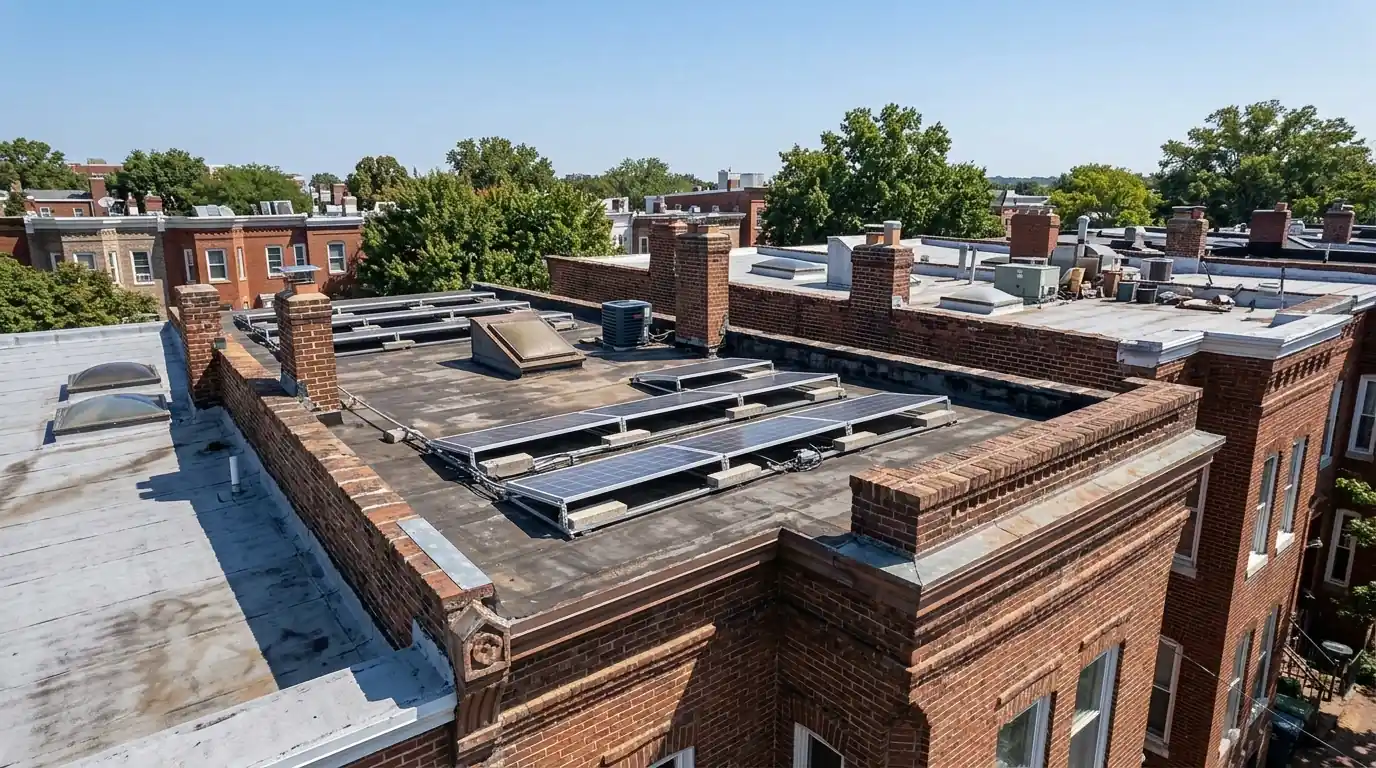
Solar on a flat DC rowhouse roof usually goes on low tilted racks set back behind the front parapet, which keeps the panels out of street view and is what DC's historic guidance asks for on flat roofs. The rack is held by ballast blocks or a few flashed attachments, and the roof membrane is checked first because replacing it later means lifting the array.
What the job is
How solar works on a flat rowhouse roof
A flat roof gives a designer more freedom than a pitched one. Panels can face due south whatever the street does, at a tilt chosen for production and wind, in rows spaced so they do not shade each other in winter. The trade is that the rack, not the roof, sets the angle, so it has to be engineered for wind uplift.
The roof covering matters more here than on any other job. Most rowhouse roofs are a rubber or modified bitumen membrane, and an array that outlasts it means lifting everything to reroof. We check the membrane's age and condition first and tell you plainly if it should be replaced before the panels go on.
What moves the price
What moves the price on a flat roof
- Membrane conditionAn aging membrane may need replacing before installation.
- Structural capacityWeak framing pushes the design from ballast toward attachments.
- AccessHoisting panels and ballast up a three-story rowhouse takes planning.
- Historic reviewExtra drawings and sightline studies on protected blocks.
2026 planning ranges
- Residential solar in DC, installed$3.00 to $3.40 per watt installedSource: cityrenewables.com
Published market ranges, not our quote. Your price depends on the roof, the equipment and the permit path.
Inside this job
Ballasted tilt racking
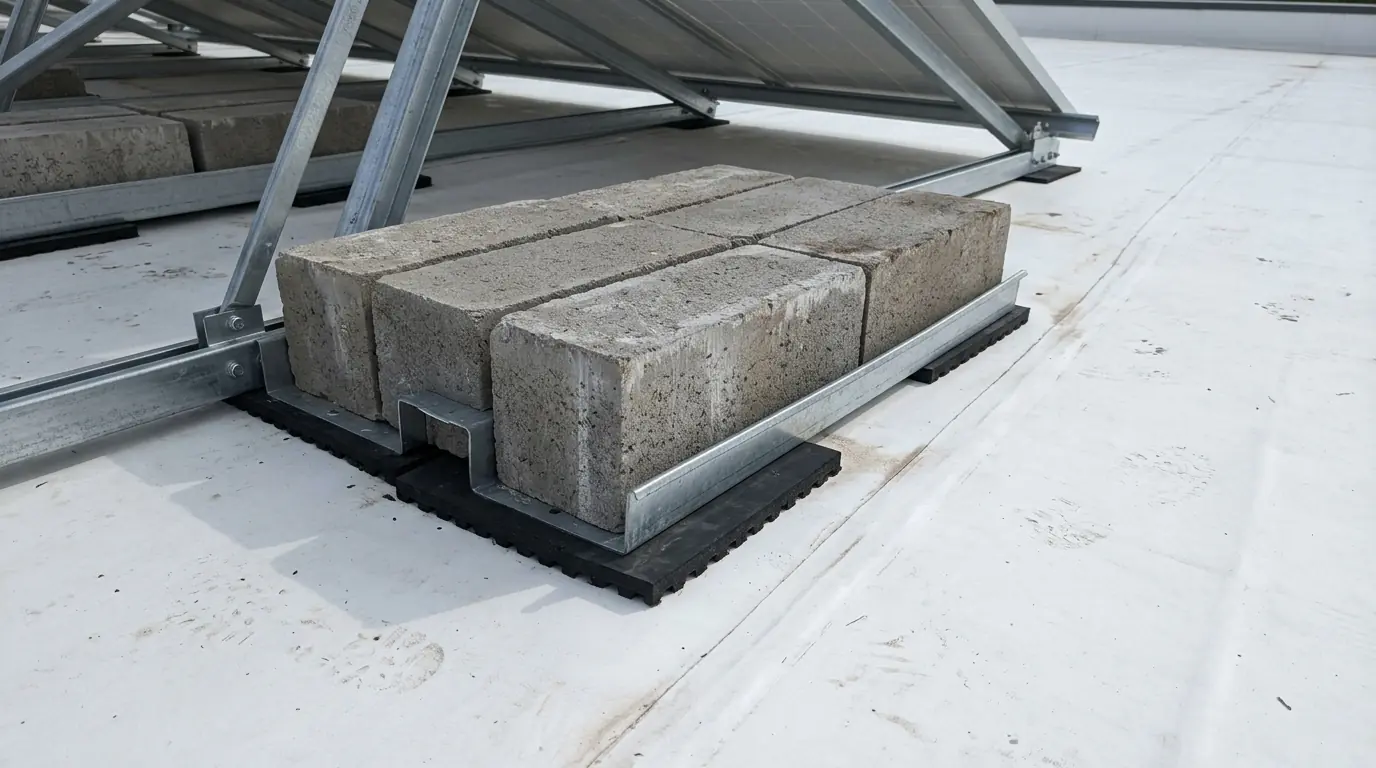
Ballasted racks sit on the roof on protection pads and are held down by concrete blocks rather than screws through the membrane. The number of blocks comes from a wind calculation for the roof height and location, and the total weight is checked against what the roof framing can carry. No penetrations means less risk of leaks, which is why ballast is the first option we look at on a sound flat roof.
Attached racking on membrane roofs
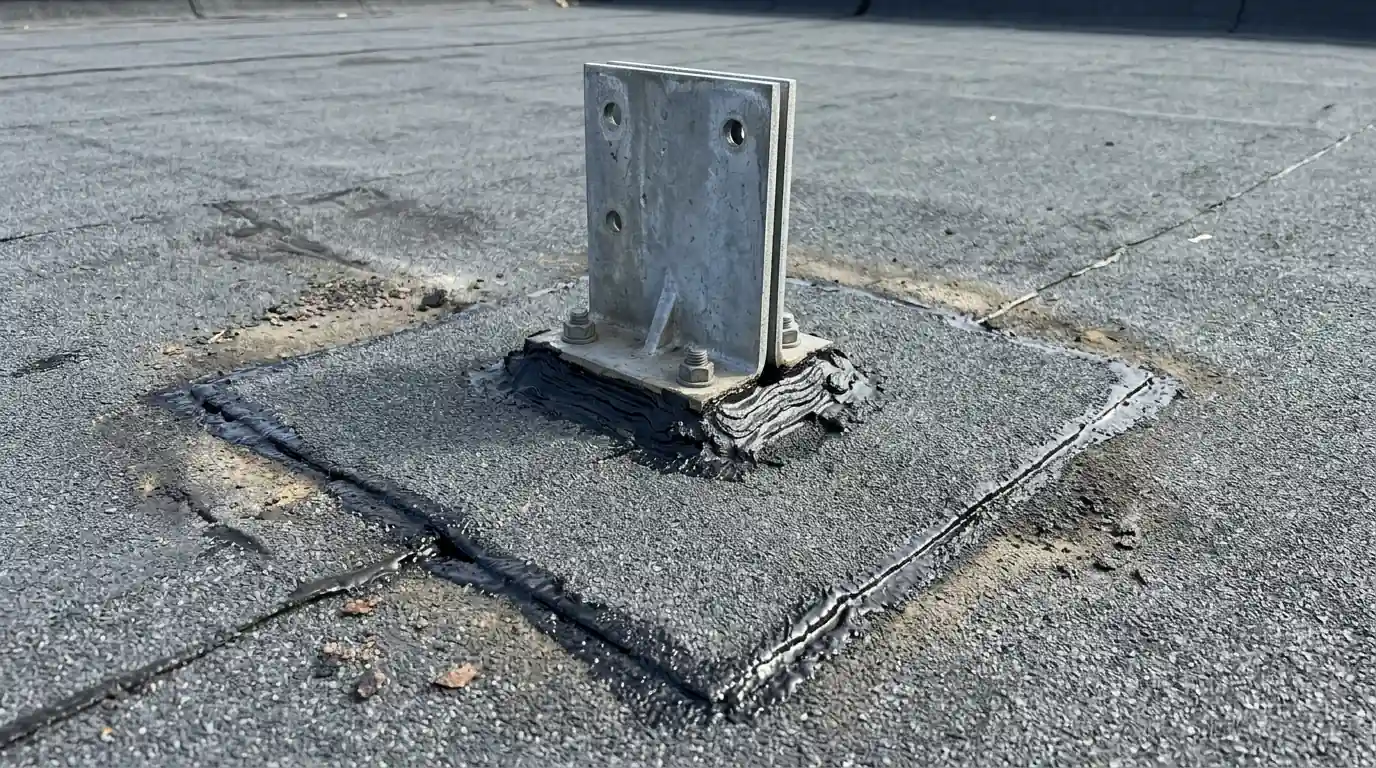
Where the roof cannot carry ballast weight, or the array sits near an edge where wind loads are highest, we use attached racks: a few structural anchors fastened into the framing and flashed into the membrane with matching material. Some installs mix the two, with light ballast across the middle and attachments at the corners. Every penetration is sealed with a method the membrane maker approves.
Parapet and party wall layouts
Rowhouse roofs come with neighbors on both sides, a parapet at the front, a hatch or a bulkhead, vents and sometimes a roof deck. The layout keeps panels back from the front parapet so they stay out of street view, clear of the party walls and drains, and leaves a walkway to the hatch. Shade from a taller neighbor or a chimney decides where the rows stop.
Choosing between options
Ballasted or attached rack?
| Ballasted rack | Attached rack | |
|---|---|---|
| Roof penetrations | None or very few | A handful, flashed |
| Weight on the roof | Higher, from the blocks | Lower |
| Best for | Sound roofs with structural capacity | Weak framing or high wind zones |
| Reroofing later | Lift rack and blocks | Remove anchors and reflash |
Washington conditions
Why flat roofs suit DC's historic blocks
Single-family homes make up about 30 percent of DC's housing units but about 80 percent of its residential buildings, which means a city of small roofs, many of them flat rowhouse roofs. In an HPRB staff report from Anacostia the guidance quoted is that solar on a flat roof should sit where the public street cannot see it, and a low rack set back from the parapet does exactly that. The Historic Preservation Office also says thousands of buildings in DC historic districts already carry solar.
Step by step
How a rowhouse solar install runs
Call
Address, roof age if you know it and what you pay Pepco.
Roof check
Membrane, framing, parapets, hatch and shade inspected.
Layout and price
Rack type, panel rows and a written price.
Permits and review
Building permit, Pepco and any preservation review.
Install
Pads, rack, ballast or anchors, panels and wiring.
Turn on and register
Inspection, permission to operate and SREC certification.
Flat-roof systems we build often use Unirac or IronRidge tilt racking with all-black REC or Qcells panels and Enphase microinverters.
Time on site
How long a rowhouse install takes
Most of the calendar goes to permits, any historic review and Pepco's interconnection. On the roof itself, a typical rowhouse system goes up quickly once materials are hoisted, because flat-roof racks assemble faster than pitched-roof attachments.
Getting materials onto the roof is often the slowest part. Narrow stairs and roof hatches mean panels and blocks go up by hand or by a small lift, which we plan before install day.
Straight answers
Rowhouse & Flat Roof Solar questions we hear in DC
Yes. Flat membrane roofs are among the simplest roofs for solar when the rack is designed for them. We check the membrane's condition first.
Not when the rack sits on protection pads and the weight is checked against the roof framing. We run that calculation before designing a ballasted system.
Panels set back behind the front parapet are usually not visible from the street. Neighbors with taller houses may see them from above.
Replace it first if you can. Lifting a finished array to reroof costs far more than doing the roof before the panels go on.
Often yes, by fitting the array around the deck or putting a canopy over it.
They set the edges of the layout. We keep panels clear of shared walls and drains and leave access to the hatch.
Related work
Jobs that often come up alongside this one
Residential Solar Panel Installation
Pitched roof systems, from layout and permits to Pepco sign off.
See this job about Residential Solar Panel InstallationHistoric District Solar
Layouts and review packages for homes under preservation rules.
See this job about Historic District SolarRoof Deck Solar Canopies
Panels on a raised frame over a roof deck or patio.
See this job about Roof Deck Solar CanopiesGround-Mount Solar
Arrays on posts in the yard where the roof will not work.
See this job about Ground-Mount Solar