Credits and paperwork
DC SRECs in 2026: what each credit pays and how to file for yours
In Washington, the credits a solar system earns can matter as much as the power it makes. Here is how DC SRECs work in 2026, what they sell for, and how to make sure every credit your roof earns is actually counted.

About this article
- Written by
- Orville Merriweather
- Role
- Solar Guides Editor
- Updated
- October 2026
- Reading time
- 8 minutes
Article
By Orville Merriweather, Solar Guides Editor. Updated October 2026.
Short answer
A DC SREC is a credit for each megawatt-hour a certified solar system inside the District produces. In 2026 they sold for about $360 to $455 each depending on vintage and contract, which typically adds $2,200 to $3,200 a year for a home system. Only systems physically located in DC qualify.
What a DC SREC is
A solar renewable energy credit, or SREC, is created every time a certified system produces one megawatt-hour of electricity. Electricity suppliers in the District must buy enough of them each year to cover a set share of the power they sell. For 2026 that solar requirement is 5 percent, and it rises toward 9 percent by 2032.
Suppliers that come up short pay a solar alternative compliance payment instead, set at $440 per megawatt-hour for 2026. That payment acts as a ceiling: nobody pays much more for a credit than the penalty for not having one, which is why DC SREC prices sit just below it.
What a credit sells for in 2026
DC SRECs sold for roughly $360 to $455 each in 2026, depending on the year the credit was generated and the kind of contract behind the sale. For a typical home system, that works out to about $2,200 to $3,200 a year.
The arithmetic is simple. Every megawatt-hour your system produces becomes one credit, so a system that makes seven megawatt-hours in a year earns seven credits. The price you actually receive depends on a few choices.
| What moves your price | Why it matters |
|---|---|
| Vintage | Credits from the current year are what most buyers need for compliance now. |
| Contract length | Multi-year contracts trade some upside for a predictable price. |
| Broker or aggregator fees | Most homeowners sell through an aggregator, which takes a share. |
| Timing | Credits can be held and sold later, within their shelf life. |
Who qualifies
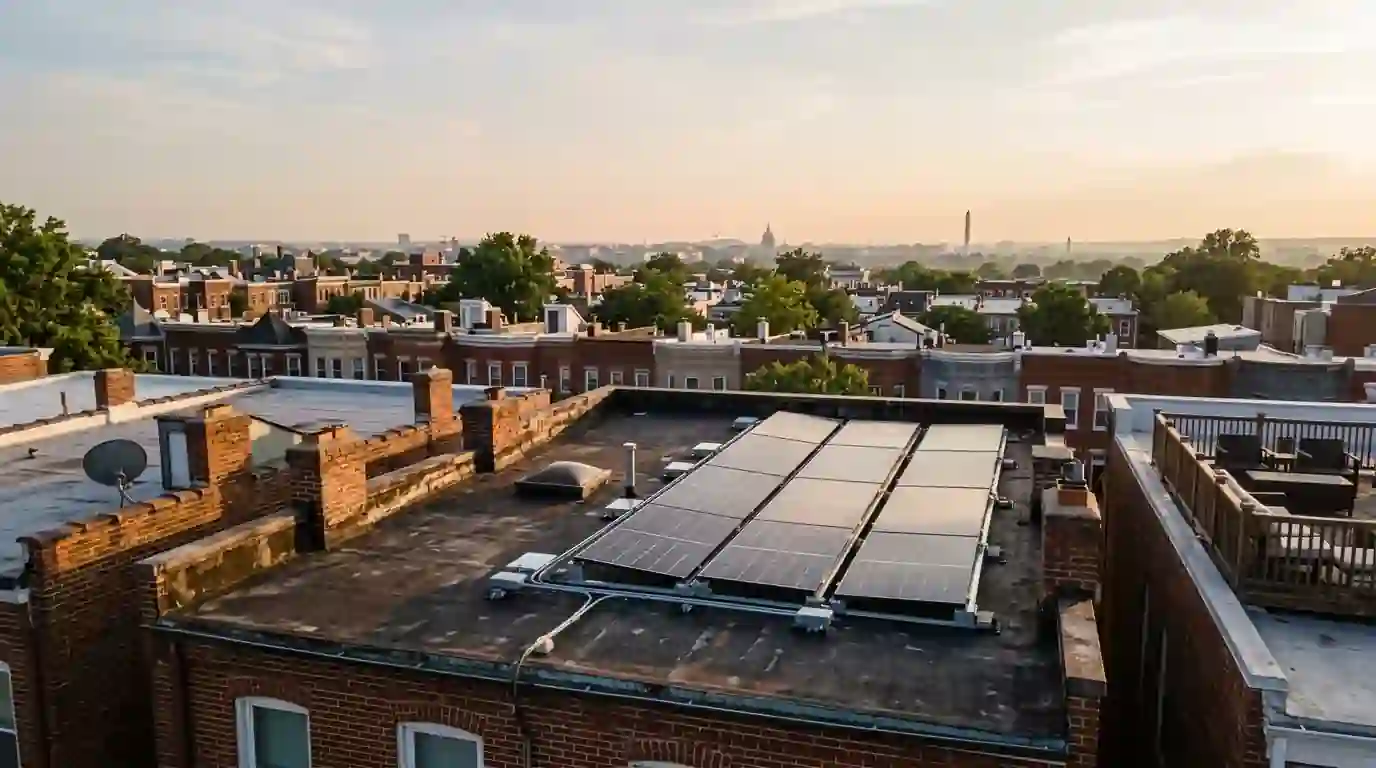
Since 2011, only solar systems physically located inside the District can earn DC SRECs. A house a few blocks over the line in Maryland or Virginia earns its own state's credits, which are worth far less. That rule keeps DC's credit supply limited to its own rooftops, and it is the main reason the price has stayed high.
The system also has to be certified before it can create credits. Production from before certification is not counted, so registering promptly after turn-on matters.
How certification works
After Pepco grants permission to operate, the system is certified with the DC Public Service Commission and set up in PJM's GATS tracking system, where its production is recorded. Each month, production readings create credits in that account, which can then be sold.
- Pepco grants permission to operate.
- The system is certified with the DC Public Service Commission.
- A GATS account records production and creates credits.
- Credits are sold on the spot market or under a contract.
Most installers file this paperwork for you, but it is worth confirming in writing who is responsible, because an uncertified system quietly produces credits nobody can sell.
A year of credits, month by month
Credits follow the sun. A DC system produces most of its megawatt-hours from spring through early fall, when days are long and the sun is high, and far fewer in December and January. That means most of a year's credits arrive in the warmer months, and a winter statement that looks thin is usually normal.
Credits are created when production is reported to the tracking system, not the moment the panels make power. Whether that reporting happens automatically from your monitoring or from meter readings submitted on a schedule depends on how the account was set up. If reporting stops, credits stop, even though the system is still producing.
A useful habit is to compare credits issued against production in your monitoring app twice a year. If the two drift apart, the reporting link needs attention.
Selling: spot, contracts and shelf life
There are two common ways to sell. Spot sales go through an aggregator at the current price, credit by credit. Contracts lock a price for several years, trading possible upside for certainty. Either can make sense; what matters is understanding the fees and the term before you sign.
A DC SREC has a five year shelf life, so a credit generated in 2026 can still be sold for compliance through 2030. That gives owners some room to hold credits rather than sell into a weak month.
Questions to ask an SREC aggregator
Most homeowners sell through an aggregator or broker rather than finding buyers themselves. Their terms vary more than people expect, so it is worth asking before signing.
- Is the fee a percentage of each sale or a flat amount, and is it deducted before payment?
- How often are credits sold and how quickly are you paid?
- How long is the contract, and what does it cost to leave early?
- Do they handle reporting to the tracking system, or is that on you?
- What happens to the account and any open contract if you sell the house?
Clear answers to these five are a better sign than a slightly higher headline price.
What if prices fall
The $440 alternative compliance payment for 2026 sets a ceiling on DC SREC prices, not a floor. As more systems are built inside the District, supply can catch up with the rising solar requirement, and prices can soften.
That is the case for a multi-year contract if you want certainty, and for keeping payback estimates conservative either way. A system whose numbers still work at a lower credit price is a safer purchase than one that only works at today's top price.
Mistakes that leave credits unclaimed
- Monitoring that dropped off Wi-Fi, so production was never reported.
- A house bought with solar where the certification and account were never moved to the new owner.
- An expansion added without updating the system's certified capacity.
- An installer that closed, leaving the account in its name with no one checking it.
Each of these can cost a full year of credits or more before anyone notices. A quick check of the account and the monitoring once a year is the cheapest insurance there is.
Sources
- City Renewables: DC SREC prices in 2026
- City Renewables: DC SREC guide
- Xpansiv: District of Columbia SREC market
Figures are as published by the sources above in 2026 and can change. Call (202) 978-0232 to check how they apply to your address.
Related work
Jobs this article connects to
DC SREC Registration
Certification, account setup and transfers handled for you.
See this job about DC SREC RegistrationLow Solar Production Diagnostics
Find out why production or reporting stopped.
See this job about Low Solar Production DiagnosticsSolar Inspection for Home Sales
Credit and warranty transfers checked before closing.
See this job about Solar Inspection for Home SalesKeep reading
More from the blog
Life After 25D: Solar Economics in DC Now
The homeowner credit ended in 2026. Why solar in the District still pays, and what to check first.
Crossing the District Line: DC, MD and VA Incentives
DC, Maryland and Virginia credit solar very differently. A side by side look at 2026.
Straight answers
Questions readers ask
One for every megawatt-hour it produces after certification. Production depends on system size, roof orientation and shade.
No. Since 2011 only systems physically inside the District qualify.
A DC SREC has a five year shelf life, so a 2026 credit can be sold for compliance through 2030.
The certification and tracking account need to be transferred to the buyer. Credits generated before closing usually stay with the seller.
Tell us what you want the system to do
Give us the address and the goal: lower bills, backup power, an EV charger or a fix. We will say plainly whether it fits and what the job involves.
Phones answered 24/7 from our 4702 14th St NW office.
Call us, or find the office
- Phone
- (202) 978-0232
- Hours
- Answered 24 hours a day, every day
- Service office
- 4702 14th St NW, Washington, DC 20011
- Head office
- 743 South Route 73, Berlin, NJ 08009
Map of our service office at 4702 14th St NW, Washington, DC. It loads only when you ask for it.