Prices and payback
What a solar system costs in Washington, DC this year, and why
Solar quotes in DC can look wildly different until you put them on the same basis. Here is the 2026 price range, the add-ons that move it, the credits that bring it back down, and a worked example you can check against your own quote.

About this article
- Written by
- Orville Merriweather
- Role
- Solar Guides Editor
- Updated
- October 2026
- Reading time
- 8 minutes
Article
By Orville Merriweather, Solar Guides Editor. Updated October 2026.
Short answer
A fair 2026 price for residential solar in Washington, DC is about $3.00 to $3.40 per watt installed before incentives, or roughly $15,000 to $18,000 for a 6 kW system. The federal homeowner credit has ended, but DC SRECs, worth about $2,200 to $3,200 a year for a typical home, and full retail net metering still carry the payback.
The number to start with
Price per watt is the fairest way to compare quotes, because it removes the effect of system size. In 2026, a fair price for a residential system in the District is about $3.00 to $3.40 per watt installed, before incentives. A 6 kW system, a common size for a rowhouse, lands around $15,000 to $18,000.
Quotes well below that range usually leave something out, such as the electrical work, the permit and interconnection paperwork, or the SREC registration. Quotes well above it should come with a reason you can see on paper.
Where the money goes
A solar price covers more than panels. Equipment is one part: the modules, the inverter or microinverters, racking and wiring. Labor is another: design, roof work, electrical connection and testing. The rest is the work nobody sees on install day, which includes permits, the Pepco interconnection, inspection scheduling, SREC registration, and the company's overhead and warranty reserves.
When a quote is much cheaper, it is usually cheaper in that last group. Ask what is included in the paperwork and the warranty, because those are the parts that matter in year five.
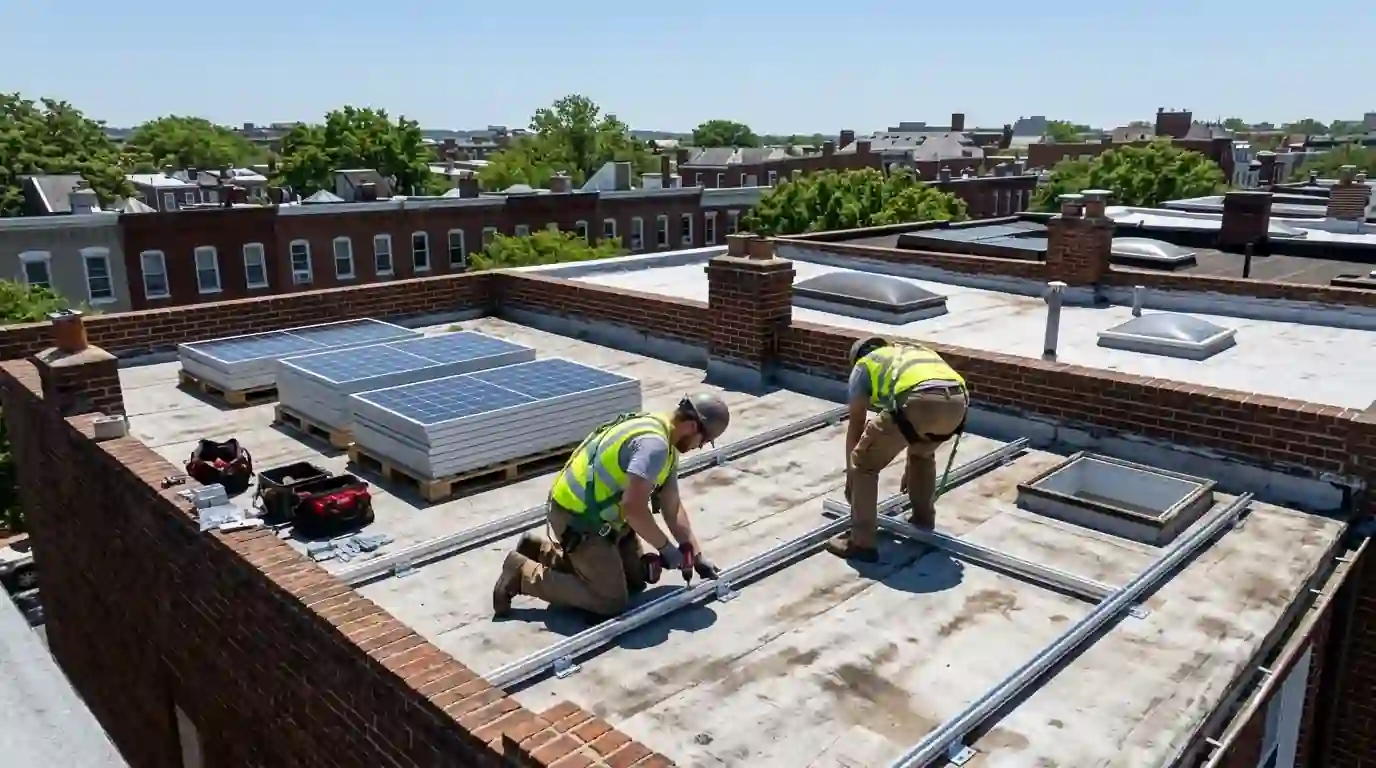
What pushes a quote up
The roof and the electrical panel decide most of the variation. A flat rowhouse roof with ballasted racking prices differently from a pitched shingle roof; a full 100 amp panel may need work before solar can connect; historic district review adds drawings and time.
| Common add-on | Typical 2026 range |
|---|---|
| Home battery, about 10 kWh | $12,000 to $16,000 installed |
| Tesla Powerwall 3 | $13,000 to $16,500 installed |
| Level 2 EV charger | $800 to $3,000 installed |
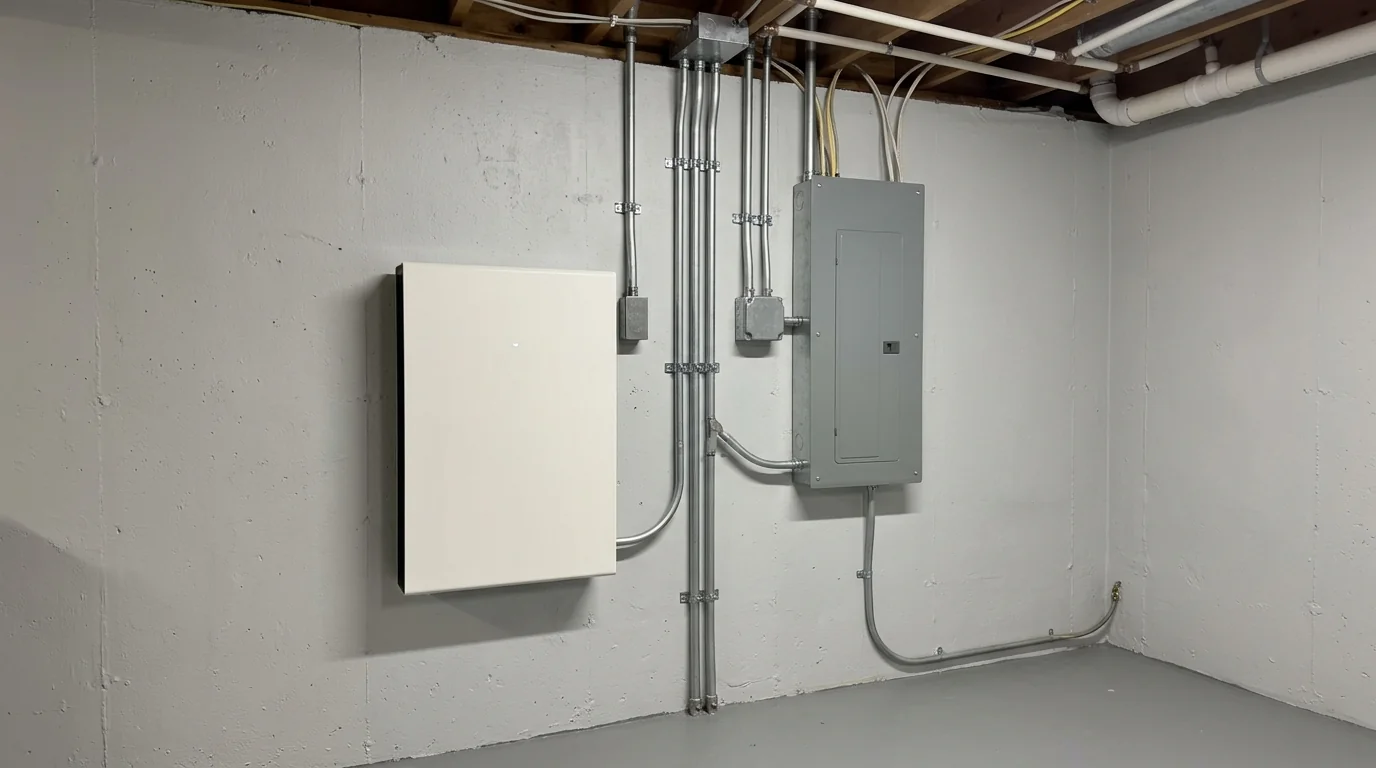
| 100 to 200 amp panel upgrade | $1,000 to $5,000 |
| Critter guard added during the install | $300 to $800 |
None of these are required for solar to work, so it is worth seeing them priced separately rather than folded into one number.
Rowhouse or detached house
Small systems cost more per watt, because the permit, design, interconnection and the trip itself cost roughly the same whether the roof holds twelve panels or thirty. Many DC rowhouses carry modest systems, so they often land toward the upper end of the per-watt range even when the total price is lower.
Flat-roof racking and roof access also move the number. A ballasted rack on a membrane roof is priced differently from rails on shingles, and getting materials up through a hatch on a three-story rowhouse takes planning and labor. Detached houses with larger pitched roofs tend to price lower per watt and higher in total.
What brings the net cost down
The federal 25D credit for homeowner-owned systems ended on January 1, 2026, so it no longer reduces the price. What remains in the District is stronger than in most places. DC SRECs sold for about $360 to $455 each in 2026, which typically adds $2,200 to $3,200 a year for a home system, and Pepco credits exported solar at the full retail rate under net metering.
For households at or below 80 percent of area median income, DC's Solar Advantage Plus rebate offers up to $10,000 toward solar or solar plus storage. Solar for All was waitlisted as of mid-2026.
A worked example
Take a 6 kW system at $16,500, the middle of the range. If its credits bring in $2,200 to $3,200 a year, the SRECs alone would repay the system in about five to seven and a half years. The savings on the Pepco bill come on top of that and shorten the payback further.
An example, not a promise
SREC prices move with the market, and every roof produces differently. Use this to sanity-check a quote, then ask the installer for a production estimate for your address.
The example also shows why registration matters. A system that is never certified for SRECs loses most of its DC advantage.
Paying cash, borrowing or leasing
Paying cash or using a loan keeps the system in your name, so the SRECs and the net metering savings are yours. A loan adds interest but spreads the cost; in DC, the yearly credit income can cover a meaningful share of the payments.
Leases and power purchase agreements need a closer look. In many DC leases the leasing company keeps the SRECs, which are most of the District's solar value. A lease can still make sense for someone who wants lower bills with no upfront cost, but compare it with ownership on paper before signing.
How to compare quotes
- Put every quote on a price per watt basis, using the same system size.
- Check the equipment list: panels, inverter type and racking.
- Confirm who files the permit, the Pepco interconnection and the SREC certification.
- Ask whether the roof and the main panel were inspected before pricing.
- Read the workmanship warranty, not just the manufacturer warranties.
A quote that answers all five clearly is easier to trust than a cheaper one that leaves them open.
Sources
- City Renewables: Cost of solar per watt in DC, 2026
- City Renewables: Electrification incentives in DC after the federal ITC sunset
- City Renewables: DC SREC prices in 2026
- EnergySage: DC solar rebates and incentives
- A1 Solar Store: Solar battery storage cost
- EV Lectron: Cost to install a home charging station
- Jouleio: EV home charging station cost
- NuWatt Energy: Solar critter guard
Figures are as published by the sources above in 2026 and can change. Call (202) 978-0232 to check how they apply to your address.
Related work
Jobs this article connects to
Residential Solar Panel Installation
Design, permits, install and SREC registration in one job.
See this job about Residential Solar Panel InstallationRowhouse & Flat Roof Solar
Ballasted or attached racks behind the parapet.
See this job about Rowhouse & Flat Roof SolarElectrical Panel Upgrade for Solar
Making room in the panel before the solar connects.
See this job about Electrical Panel Upgrade for SolarKeep reading
More from the blog
Life After 25D: Solar Economics in DC Now
The homeowner credit ended in 2026. Why solar in the District still pays, and what to check first.
DC SRECs in 2026: What a Credit Pays and How to File
What a DC SREC sells for now, how certification works, and why an unregistered system leaves money on the roof.
Straight answers
Questions readers ask
About $15,000 to $18,000 installed before incentives in 2026, or $3.00 to $3.40 per watt.
Often because something is left out, such as panel work, permits or SREC registration. Compare on the same scope.
Yes. A 10 kWh class battery typically adds $12,000 to $16,000 installed.
Income-qualified households may be eligible for the Solar Advantage Plus rebate of up to $10,000. Solar for All was waitlisted as of mid-2026.
Tell us what you want the system to do
Give us the address and the goal: lower bills, backup power, an EV charger or a fix. We will say plainly whether it fits and what the job involves.
Phones answered 24/7 from our 4702 14th St NW office.
Call us, or find the office
- Phone
- (202) 978-0232
- Hours
- Answered 24 hours a day, every day
- Service office
- 4702 14th St NW, Washington, DC 20011
- Head office
- 743 South Route 73, Berlin, NJ 08009
Map of our service office at 4702 14th St NW, Washington, DC. It loads only when you ask for it.