Keeping it running
Production Dropped? Twelve Things to Check
Low production can be a tripped breaker, a dead Wi-Fi link, a new shadow or a failed part, and they all look alike on a chart. Work through this list in order. The first six you can check yourself; the rest need a technician.
About this article
- Written by
- Orville Merriweather
- Role
- Solar Guides Editor
- Updated
- October 2026
- Reading time
- 8 minutes
Article
By Orville Merriweather, Solar Guides Editor. Updated October 2026.
Short answer
When a DC solar system's production drops, start by comparing sunny days with the same period last year, then check the monitoring connection, the inverter's lights and error codes, the solar breaker, new shade and visible soiling. If those look fine, string testing, panel electronics, ground faults and SREC reporting are the next checks.
Start with the right comparison
Monthly totals swing with the weather, so a cloudy October can look like a fault. Compare clear days with clear days, and this month with the same month last year. A system that produces normally on sunny days is probably healthy, whatever the monthly total says.
Panel-level monitoring makes this easier: one panel far below its neighbors points to that panel or its electronics, while every panel down together points to something shared.
Checks you can make from the ground
- Is the monitoring app showing current data, or has it stopped updating?
- What color are the inverter's lights, and is there an error code on its display?
- Has the solar breaker in the main panel tripped?
- Is the outdoor AC disconnect switched on?
- Has anything new started shading the roof, such as a tree that grew or a neighbor's addition?
- Can you see heavy soiling, pollen film or bird droppings on the panels from the ground?
Safety first
If you smell burning, hear buzzing, or the inverter reports a ground fault, leave the system off and call. Do not reset a breaker more than once.
Checks that need a technician
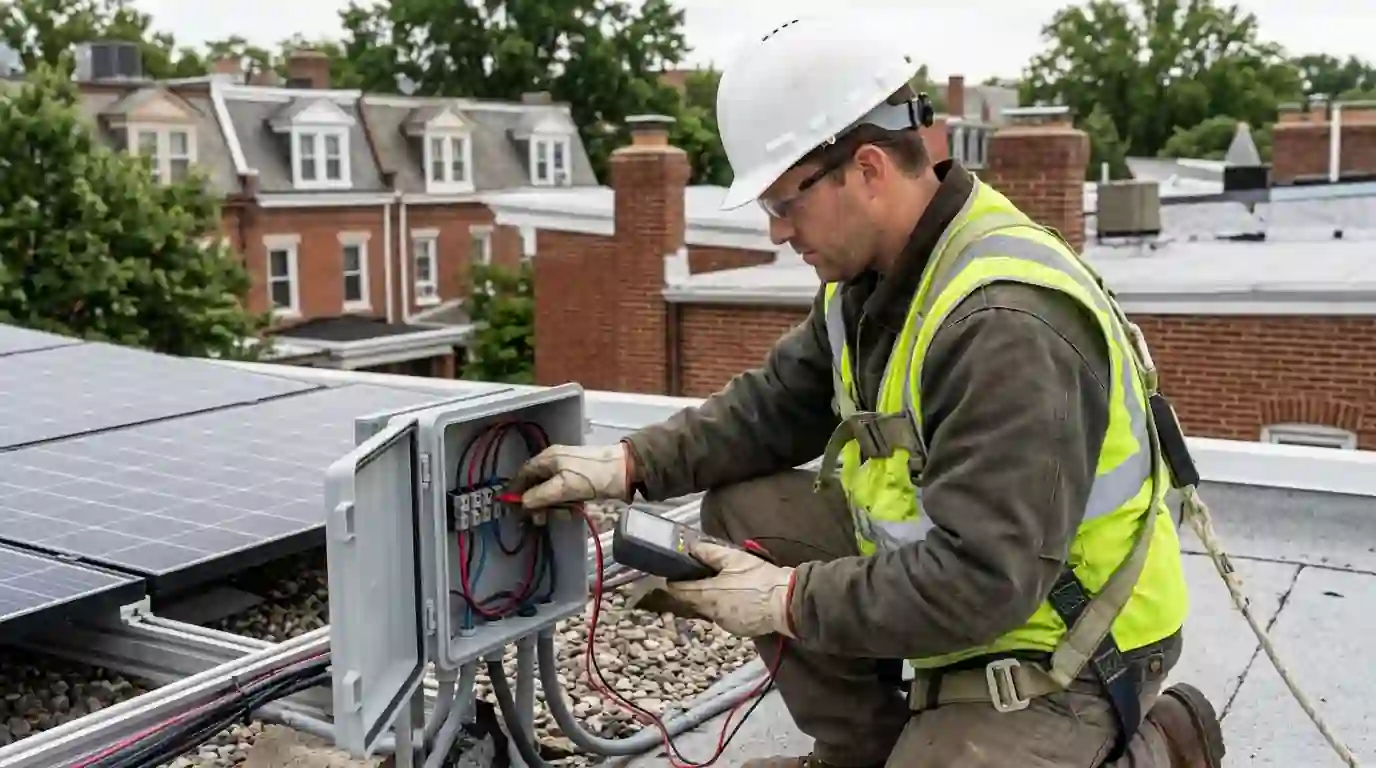
- String voltage and current tests, compared string by string.
- Microinverters or optimizers that have failed under individual panels.
- Ground and insulation faults in the wiring.
- Connectors damaged by heat or water.
- Wiring chewed by squirrels or birds under the array.
- Whether production is actually reaching the meter and the SREC account.
Out of warranty, minor inverter repairs typically cost $150 to $400, and a failed microinverter about $150 to $350 per unit installed, so finding the actual fault first is worth the visit.
The most common false alarm
A monitoring link that drops off Wi-Fi after a router change makes a working system look dead. The panels keep producing and the meter keeps counting, but the app shows nothing. Reconnecting the gateway fixes the display.
It still deserves attention, because in DC that same link often reports production for SRECs. A system that kept producing while the reporting stopped may have credits that were never issued.
Seasonal drops and real faults
Production falls every winter as the sun sits lower and days get shorter, and it can dip in spring when trees leaf out. These changes are gradual and affect the whole system. A sudden step down, or one string or panel falling behind the rest, is what points to a fault.
Keep a simple production log
The easiest way to spot a slow decline is a log. Once a month, note the system's total production from the monitoring app or the production meter, along with anything unusual: a storm, roof work, a tree trimmed or a new building next door.
Compare each month with the same month the year before. A difference of a few percent is weather; a steady slide over several months, or a sudden drop that weather cannot explain, is worth a technician's visit. The log also makes a diagnostic visit faster, because it shows when the change began.
Two numbers to keep
Write down the production meter reading on the first of each month, and the SREC credits issued for that month when they arrive. If one moves and the other does not, the reporting link needs attention.
What lost production costs in DC
Every megawatt-hour a DC system fails to make is one less SREC, and those sold for about $360 to $455 each in 2026. The same production would also have offset Pepco power at the full retail rate under net metering. A fault left alone for a season costs more than most repairs.
Sources
- City Renewables: DC SREC prices in 2026
- EnergySage: DC solar rebates and incentives
- GreenLancer: Solar inverter repair
Figures are as published by the sources above in 2026 and can change. Call (202) 978-0232 to check how they apply to your address.
Related work
Jobs this article connects to
Low Solar Production Diagnostics
Testing until the cause is clear, before any part is replaced.
See this job about Low Solar Production DiagnosticsSolar Inverter Repair & Replacement
Faults read, repaired or replaced and claimed.
See this job about Solar Inverter Repair & ReplacementMicroinverter & Optimizer Replacement
Panel-level electronics swapped on the roof.
See this job about Microinverter & Optimizer ReplacementKeep reading
More from the blog
DC SRECs in 2026: What a Credit Pays and How to File
What a DC SREC sells for now, how certification works, and why an unregistered system leaves money on the roof.
Pigeons Nesting Under Panels: What Works
Why pigeons love rooftop arrays, what actually keeps them out, and what does not.
Straight answers
Questions readers ask
Common causes are new shade, soiling, a failed string or panel electronics, or an inverter fault. Compare sunny days, not monthly totals, before deciding.
Usually the monitoring lost its internet connection while the system kept producing. Reconnect it and check that production reporting resumed.
Once, if it has tripped. If it trips again, leave it off and call, because it points to a fault.
Yes. Each megawatt-hour not produced, or not reported, is one less DC SREC.
Tell us what you want the system to do
Give us the address and the goal: lower bills, backup power, an EV charger or a fix. We will say plainly whether it fits and what the job involves.
Phones answered 24/7 from our 4702 14th St NW office.
Call us, or find the office
- Phone
- (202) 978-0232
- Hours
- Answered 24 hours a day, every day
- Service office
- 4702 14th St NW, Washington, DC 20011
- Head office
- 743 South Route 73, Berlin, NJ 08009
Map of our service office at 4702 14th St NW, Washington, DC. It loads only when you ask for it.