Roofs and layouts
New Roof Under Old Panels: Planning the Order
Sooner or later, most solar arrays outlive the roof under them. When that day comes, the order of work decides whether the job costs what it should and whether the system comes back the way it left. Here is how to plan it.
About this article
- Written by
- Orville Merriweather
- Role
- Solar Guides Editor
- Updated
- October 2026
- Reading time
- 7 minutes
Article
By Orville Merriweather, Solar Guides Editor. Updated October 2026.
Short answer
To replace a roof under solar panels in Washington, DC, a solar crew shuts the system down, labels and removes the panels, and stores them while the roofer works, then reinstalls and tests everything. Removal and reinstallation typically cost $250 to $400 per panel, or about $5,000 to $8,000 for 20 panels.
Why the order matters
Solar panels carry live DC wiring whenever the sun is up, and the equipment warranties expect qualified hands. A roofer who pulls panels to get at the shingles or membrane risks damaged modules, cracked connectors and lost warranty coverage, and nobody is left responsible for putting the system back together.
The clean approach is two trades with clear handoffs: solar off, roof done, solar back on. Each step has an owner, and the schedule is set before anything is touched.
Before anything comes off
Test the system first. If a string or an inverter is already failing, you want that documented before removal, so it is not blamed on the move and so it can be fixed while the array is apart anyway.
- Run a production and string test and record the results.
- Photograph the array, the wiring and the roof around it.
- Confirm in writing who removes, stores and reinstalls the panels.
- Agree on dates with the roofer so the panels are not stored for weeks.
What removal involves
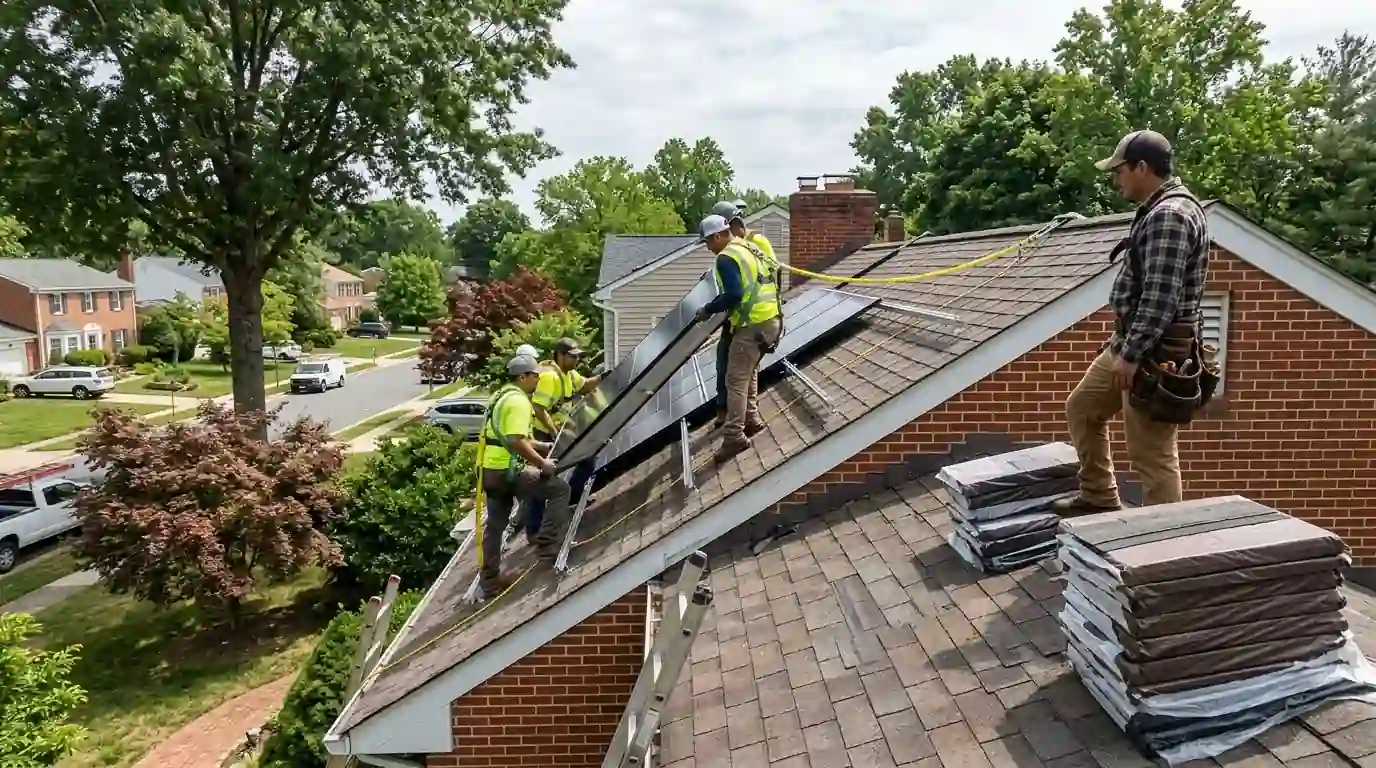
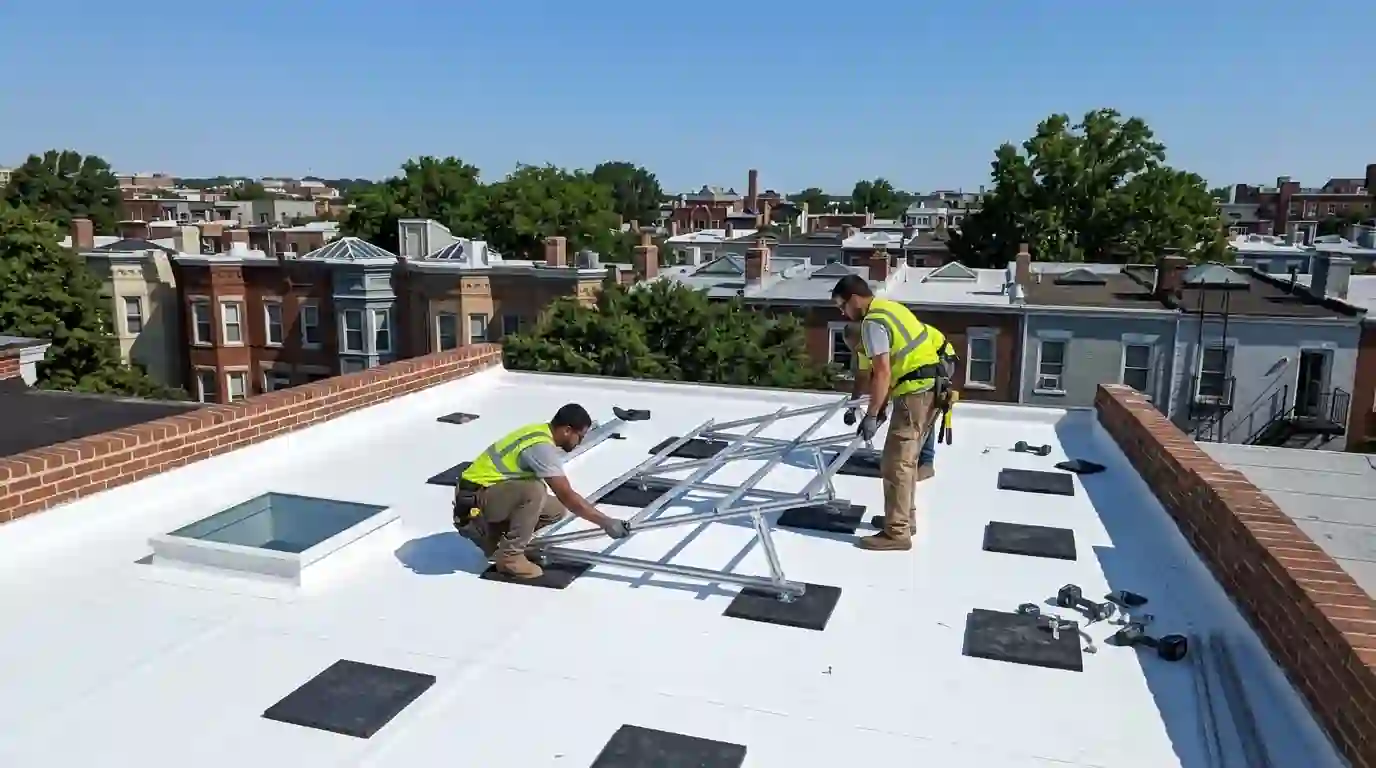
The system is shut down, each string is labeled, connectors are capped and the modules come off in an order that makes reinstallation straightforward. They are stacked on padding in a dry, secure place. On pitched roofs, the rails and attachments come off too; on flat rowhouse roofs, the ballasted rack is often lifted aside as a unit or taken apart so the membrane can be replaced underneath.
Reinstallation runs in reverse, with new flashing on every pitched-roof attachment and new protection pads under a flat-roof rack, followed by string tests and a restart.
What it costs
Removal and reinstallation typically run $250 to $400 per panel, or about $5,000 to $8,000 for a 20-panel system. Ballasted flat-roof racks, long storage periods and hard roof access push toward the top of the range.
Planning tip
If you are going solar on an aging roof, replacing the roof first almost always costs less than lifting a finished array later.
Pitched roofs and flat rowhouse roofs
About a quarter of DC's homes are row houses or other attached homes, and most of their flat roofs carry a membrane that will need replacing during the life of a solar array. On those roofs the solar side of a reroof is mostly lifting and resetting a rack. On pitched roofs it is removing and reflashing every attachment, which takes longer and needs more care.
Production, permits and credits during the gap
Every day the panels are off is a day without production or SRECs, which is why tight scheduling with the roofer matters. The SREC account itself stays in place; it simply records no production for the gap.
Reinstallation may need a permit, especially if attachments, wiring or the layout change. If equipment changes, Pepco's records may need updating as well. We check what applies before the panels come down.
Upgrades while the panels are off
With the array apart, some upgrades cost far less than at any other time.
- A critter guard, typically $300 to $800 when fitted during an install, against $500 to $1,500 as a retrofit.
- Replacing an aging string inverter before it fails.
- Adding optimizers or microinverters for panel-level monitoring.
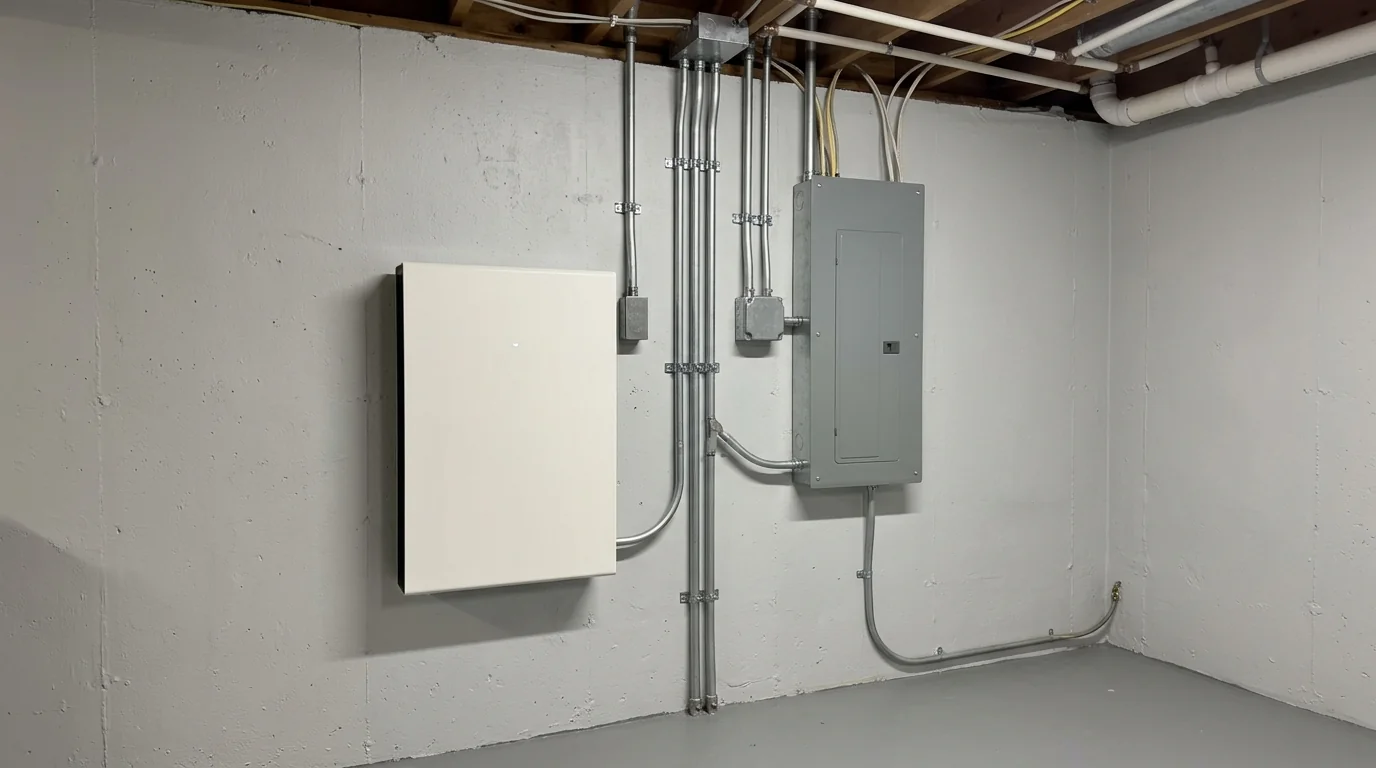
- Running conduit and leaving space for a future battery gateway.
- Adjusting the layout around new vents or a roof deck.
A simple timeline
- Plan dates with the roofer and the solar crew together.
- Test and document the system.
- Removal day: shutdown, labeling, removal and storage.
- Roof work by the roofer.
- Reinstall day: panels back with new flashing or pads.
- Restart, string tests and a production check in the monitoring.
Sources
- Southern Energy: Solar panel removal and reinstall
- NuWatt Energy: Solar critter guard
- NeighborhoodScout: Washington, DC real estate data
- City Renewables: DC solar permit guide
Figures are as published by the sources above in 2026 and can change. Call (202) 978-0232 to check how they apply to your address.
Related work
Jobs this article connects to
Solar Panel Removal & Reinstallation
Removal, storage and reinstall timed with your roofer.
See this job about Solar Panel Removal & ReinstallationRoof Leak Repair Around Solar Mounts
Leaks under an array traced and repaired properly.
See this job about Roof Leak Repair Around Solar MountsRowhouse & Flat Roof Solar
Flat-roof racks reset on new protection pads.
See this job about Rowhouse & Flat Roof SolarKeep reading
More from the blog
Rowhouse Roofs and Solar: Parapets, Hatches, Drains
Parapets, hatches, party walls and drains: what a flat rowhouse roof means for a solar layout.
Production Dropped? Twelve Things to Check
Twelve checks, from the breaker to the shade, before you pay anyone to fix low production.
Straight answers
Questions readers ask
It is not a good idea. The panels carry live DC wiring and warranty-sensitive equipment, so a solar crew should shut the system down and remove them.
Typically $250 to $400 per panel, or about $5,000 to $8,000 for 20 panels.
For the length of the roof work plus a day on each end for removal and reinstallation, when the trades are scheduled together.
Often, especially if anything about the attachments, wiring or layout changes. We check before removal.
Tell us what you want the system to do
Give us the address and the goal: lower bills, backup power, an EV charger or a fix. We will say plainly whether it fits and what the job involves.
Phones answered 24/7 from our 4702 14th St NW office.
Call us, or find the office
- Phone
- (202) 978-0232
- Hours
- Answered 24 hours a day, every day
- Service office
- 4702 14th St NW, Washington, DC 20011
- Head office
- 743 South Route 73, Berlin, NJ 08009
Map of our service office at 4702 14th St NW, Washington, DC. It loads only when you ask for it.